Call/Text (251) 979-9396 or Click Here to Book Now!
If your AC has stopped working in Gulf Shores, Foley, Orange Beach, or anywhere in Baldwin County during the summer heat, there are five quick checks you can do in the next ten minutes that solve the problem about a third of the time without a service call. The other two-thirds of the time, you need a licensed HVAC technician. The sooner the call, the shorter the wait. Adam's team at Gone Coastal answers (251) 979-9396 directly during peak season.
Here is the homeowner checklist Adam Creasy gives to every customer who calls during a heat wave. Run through it before you sweat through another hour waiting for the dispatch.
Sounds obvious. Catches the problem more often than you would expect. Confirm the thermostat is set to COOL, not OFF or HEAT. Confirm the fan is set to AUTO or ON, not OFF. Confirm the temperature setting is at least three degrees below the current room temperature; if the setpoint is higher than the room reads, the system thinks it is done. Programmable thermostats sometimes revert to schedule overrides after a power flicker. Verify the current setting is what you intend.
If your thermostat is battery-powered and the display is dim or blank, swap the batteries. A dying thermostat will sometimes call for cooling weakly enough that the AC does not respond, or stop calling entirely with no obvious warning.
Pull your air filter and hold it up to a light. If you cannot see light through it, that is your problem until proven otherwise. A severely clogged filter chokes airflow so badly that the evaporator coil freezes solid, the system shuts down on safety, and no cooling reaches the house. This is the single most common cause of mid-summer AC failure in Baldwin County, and it is the easiest one to fix.
Replace the filter with a new one of the correct size and MERV rating. If you suspect the coil has already frozen, switch the thermostat to OFF and set the fan to ON to circulate air across the coil and thaw it. Allow two to four hours before turning cooling back on. If the system runs normally after the thaw, the filter was the culprit and you have just saved yourself a service call.
Go to your electrical panel. Find the breakers labeled for the air handler (indoor) and the condenser (outdoor). There are usually two. If either is tripped or in the middle position, reset it firmly to OFF and then back to ON. If a breaker trips a second time within a few minutes of being reset, stop. Do not keep resetting it. That is a signal of an actual electrical problem, and that is a call for a licensed technician immediately.
Check the disconnect box mounted on the wall near your outdoor condenser unit. Make sure the pull-out or switch is fully engaged. Storms occasionally jostle these loose, and a half-engaged disconnect will leave an otherwise healthy system completely dead.
Many modern HVAC systems have a safety float switch in the condensate drain pan that shuts the system off when the drain backs up. In coastal Alabama summers, condensate drains clog frequently with biological growth and the float switch trips. The result looks like a dead system from the homeowner's perspective.
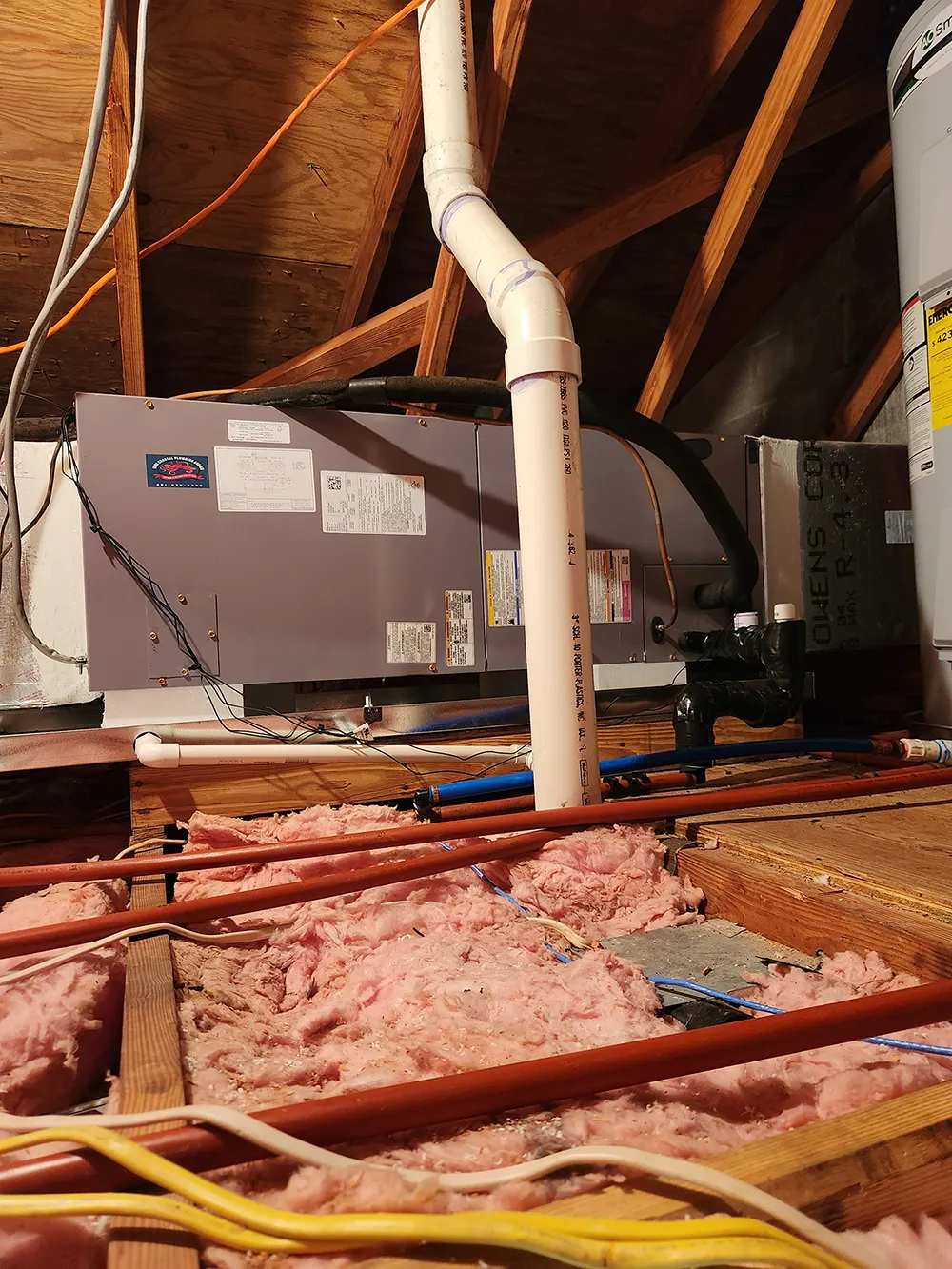
Look at your indoor air handler (usually in a closet, attic, or garage). If you see a small pan with standing water, or a hose with water visibly backed up, that is the issue. You can sometimes clear a partial clog yourself with a wet-dry vacuum on the outdoor drain termination, but if you are not sure or the system stays off after, call us. Drain clearing is a routine service we handle quickly.
Walk outside to the condenser. Is it running? You should hear the compressor humming and feel air blowing up out of the top. If the indoor system is running but the outdoor unit is silent, that is most often a capacitor failure. Capacitor failures are extremely common in Baldwin County summers, very fast to diagnose and replace, and not something to attempt as a DIY project. Capacitors store electrical charge and can deliver a serious shock even after power is cut.
If the outdoor unit is running but you are still not getting cool air inside, that points to refrigerant level, coil airflow, or an indoor air handler issue. All of those need professional diagnosis.
If you smell anything burning, see any smoke, hear unusual electrical buzzing, or find ice visibly built up on copper lines outside, stop troubleshooting and call us immediately. If you have a vacation rental with guests in the property, do not run the checks. Call right away so dispatch is moving while you are confirming the situation. And if the outdoor temperature is over 95 and you have someone in the home who is elderly, very young, or has a health condition that makes heat dangerous, that is an emergency, not an inconvenience. Tell the dispatcher exactly that when you call (251) 979-9396.
Adam's team answers (251) 979-9396 directly during peak summer. We dispatch across Baldwin County (Foley, Gulf Shores, Orange Beach, Fairhope, Daphne, and surrounding communities) with same-day response on most emergency calls. Book online any time.
We offer 24/7 emergency services! Our team is ready and eager to assist you with any inquiries you may have. At Gone Coastal, nothing is beyond our reach.